Search This Blog

Wednesday, 20 November 2019

COP Research (Other)

Video games
Overwatch (Blizzard Entertainment) Sigma
His character is shown as being mentally unstable through the use of music and reality. In gameplay, he is constantly saying "What is that melody?!" As a symphony plays in the background - however any player can hear it as any other character, suggesting he is not as insane as he is portrayed. His character fades through realities of being in space, before and after the accident, as well as a reality where he is tied down. Playing his character trailer in reverse, you can hear him saying "Hold it together".
He wears a straight jacket, making him look insane to the average player - as this is a stereotypical symbol of extreme loss of mental health. 
Unless you are an extreme player who researches in to his background, you wouldn't know that the character is under mind control and constantly fighting to regain himself - instead of the visible presentation of him being purely insane and out of mind.
Shows the struggles of real life mental health, fighting on the inside, and not constantly mentally broken. There ARE moments of fighting it.
Sigma video
Books
Inclusive Arts Practice and Research: A Critical Manifesto
"Learning-disabled artists wish to be valued as artists and individuals in their own right, rather than as representative of a category of being human."
"...until the late 1980s people with learning disabilities were often removed from society and hidden from view in institutions."
Page 38
"...you're presenting it in a way that you hope they are happy with - it can be really difficult." "You have to be quite artistically brave, actually..."
Page 125
The Disabled Body in Contemporary Art
Mary Duffy posed naked for her work, she is born without limbs. Her work shows "how her disabled body is defined by medicine and society as lacking, inadequate and undesirable."
First page of the chapter Disarming Venus
The Disabled Reader: Social Science Perspectives
Page 208
Its difficult to live as a white male heterosexual disabled person as it is. Minorities in the disabled community are strongly discriminated - and are almost never shown in the media.
Page 238
"What is life like for people with these chronic health problems?"
The question we need to be asking. Does the media show disability correctly? Do we need to show more inclusion in the media?

Sunday, 10 November 2019

COP Research (Live Action)

(8/11/19)
Joker (2019)
Based around mental health.
"Joker is constantly blurring the line between reality and fantasy."
You leave the movie questioning what was real and what was fake, very much like a mental illness. There are clocks throughout the movie that all show the exact same time, which leads people to believe the movie may just be fantasy created by his mental illness, like Schizophrenia.
Tone of the movie is fearful yet manages to equally show humor. This relates to Arthur's condition pseudobulbar affect, which makes him laugh from nowhere, often when he's nervous (in a fearful situation)
https://youtu.be/OLjjz3QOGMs
In contrast, at the talk issued by Creative Network x Thought Bubble with Brain Azzarello (7/11/19 at Leeds Arts Uni), he talked about writing the script for "Joker" Black Label. He said that "Joker wasn't about mental health." His main focus was creating a character with a dark side, like the label he was producing for. He wanted to show Joker's ability to scare people and his over all insanity- in contrast to the strong mental depiction in the current film.
Due to the strong build up of character background throughout the DC universe, I think it was impossible for Azzarello to create the Joker in a way that a modern audience wouldn't see a mental disability in him, as he has always been known to be 'mad'. The iconic laughter of the joker has been passed through every story but I think the 2019 version has identified that this is not because of his love and joy of murder, as Azzarello tried to show.

Baby Driver (2017)
Tinnitus. Baby wears earphones throughout the movie, listening to music to drown away the noise of tinnitus as well as to overcome childhood trauma of the car crash that killed his parents and gave him tinnitus. His disabled foster father, Joseph, is deaf and they communicate using ASL.
The use of music in the movie allows the audience to connect with Baby, as the album allows them to listen to what he listens to. Also, if you watch the film using headphones, the sound cuts out in an earphone when Baby removes one or one falls out of his ear. This arguably makes the viewer deaf in one ear.
(Added on 24/11/19)

Last Christmas (2019)
Just watched this in cinema. Very subtle use of Schizophrenia. Never mentioned to the public.
[Spoilers because it's a new film] The woman falls in love with the man who donated his heart to save her. She spends the movie spending time with the man, and it's revealed at the end that the man was never there. She lives inside her own world, without it being made to look crazy and maddening and colourful, like Alice in Wonderland, for instance.

Saturday, 9 November 2019

12 Principles of Animation: Follow Through, Overlap and Secondary Action

All three techniques are used to create realism within the animation.


Follow Through and Overlapping:

Follow Through is used when a character or an object stops. It is the continuation of motion after the main body has stopped moving. E.g. Hair continuing past the body when the head has stopped after a sudden movement such as running. Your arms continue to move after you've stopped running, which is important in a cycle.

Overlaps is often referred to in animation as a series of curves that are overlapped in the animation process. However this can also be the catching up of motion. For instance, if a horse walks, the mane and the tail move at a different pace to catch up to the body. This works with Follow Through, as FT stops the overlapping. The overlap is often at a different speed which creates the overlapping of animation curves.


Secondary Action:
This can be one of two things:

1) An action that follows after a motion has happened, or an action after the primary. Eg. If Batman were to jump (Primary), his cape would flick behind him. (Secondary)

2) A supporting action to the primary one. This is often subtle, such as messing with a pencil as you nervously talk. 

Both versions are used to communicate the narrative of the story or the emotion in the scene.

In my animation, my use of secondary action was the plate jumping as the table was hit. My use of overlap and follow through was the hair and how it pulls back with the hair, and turns and rests on the shoulders. This also happens in the middle as the hair bounces with a small head movement. To improve this animation, I would make the lines a more obvious colour such as red. I would also have made a more sudden head movement at the end to exaggerate the follow through a bit more. I like the hair movement as it flicks back, and I think I managed to keep it the same length in every frame, which was a concern during.

Monday, 4 November 2019

COP Research (Animated)

(2/10/19  -  links added on 9/10/19)
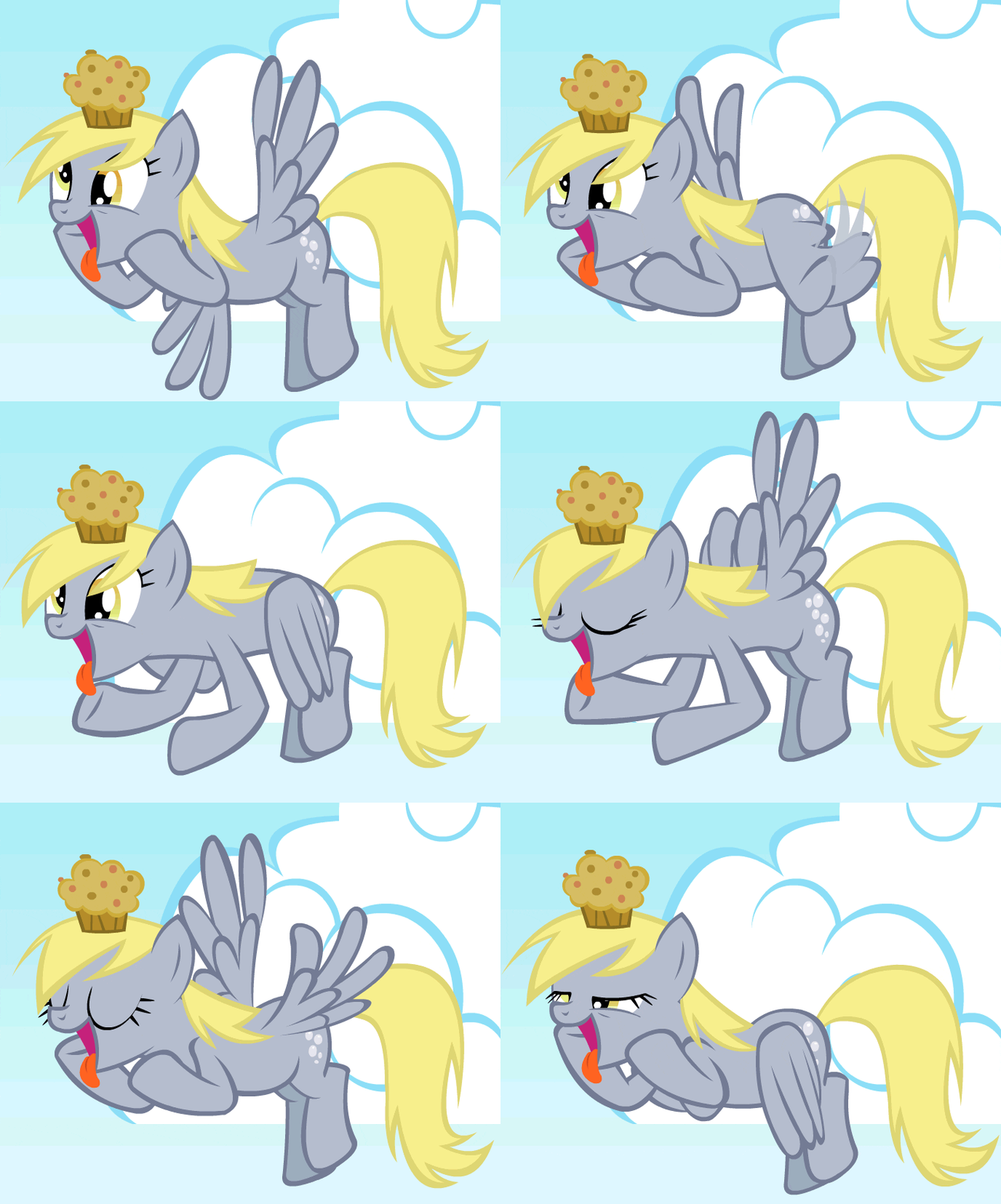
  • Derpy MLP 'The Last Roundup' intro. Clumsy cross eyed character. One of the only times you hear her voice, low and deeper, less attractive to children. Name is offensive. All indicators of her being dumber than other characters. Gerald from nemo link - similarly poor expressions of ability. https://www.youtube.com/watch?v=gzV0akONkWs (They changed her voice and eyes, and her name was deleted altogether.)
  • Hey Dougie Roly. Modern version of Tigger, childhood animated character watched by younger children. Fan suspected ADHD, shows viewer's  influence on franchise. Louder, hyperactive, energetic as described on BBCs webpage, but he can also be suddenly quiet and gentle. (https://www.heyduggee.com/characters/)
  • Timmy and Jimmy South Park. Just as capable, loved. Comedy about disabilities in a nice way. Characters aren't stupid and are just as able as the main 4, often having cooler experiences. Funny. Timmy won an award in 2008, 8 years after his character introduction. ("South Park Shortlisted In Disability Awards" by Damen Rose, Wednesday 19th November 2008 https://www.bbc.co.uk/blogs/ouch/2008/11/south_park_shortlisted_in_disa.html)

  • Winnie the Pooh, fan made theory of them all characterising a mental disorder. Allows little kids to associate and understand tough topics. Viral mental health test that showed what percentage of each character and their mental disorder you were. Theory started with Doctor Sarah Shea and her team with "Pathology in the hundred acre woods: a neurodevelopmental perspective on A.A.Milne 2000". Original journal shows Pooh showing Obesity and ADHD where as the viral test showed Pooh as ADD, and Tigger as ADHD - with other more modern interpretations as Pooh having an eating disorder. Audience's more modern views and acceptance of mental health have allowed people to interpret the characters' characteristics differently or in multiple ways to the mental health experts who wrote the original journal.

My results from the viral test: using data from Shea's journal on top of other sources
https://www.idrlabs.com/pooh-pathology/test.php
  • Nemo, ability used correctly. They don't make it obvious that EVERY character has a different disability, but everyone does and they all overcome it. So even if it's recognised, it's empowering to all audiences. Audiences were mad about Gerald and his offensive representation that him being cross eyed and having a unibrow makes him less smart.
https://tenor.com/view/gerald-finding-dory-angry-yelling-mood-gif-11663741

  • Bart Simpson ADD. Homer Simpson running gag of being dumb and small brained. Crayon in his brain. Bald, big eyes, voice = lower intelligence
  • Creature comforts (discomforts) by Aardman animations. Visibly trying to show awareness to different abilities by using disabled voice actors. Aired on Christmas Day of 2007, with extra characters added in 2008.
http://www.thunderchunky.co.uk/articles/creature-discomforts/

  • Peppa Pig recently adding in a character in a wheelchair
  • Live action very good use of ability is Baby Driver. Subtle yet very relatable. Use of music as comfort allowed for audiences to get behind the character by enjoying the music album and also listening to it with headphones. This is encouraged by the production team, as if you watch Baby Driver with headphones in, whenever one of Baby's earphones are removed, the music cuts in that earbud.

Saturday, 2 November 2019

12 Principles of Animation: Exaggeration

Exaggeration is using unrealistic proportions and overly expressive reactions to create an animated feeling of intensity.
Though this isn't the best illustrated, I think that the camera shake, the elephant's screaming expression, and the jaws of the mouth show clear exaggeration of the given sound effect of the scream. I feel like the exaggeration of the mouse would be more noticeable if the staging of the elephant was less central, and the proportion of the mouse was not so realistic and possibly started larger. (Or the elephant started smaller).

12 Principles of Animation: Antici....paaa...tion

Anticipation is the viewer's hope or expectation for an action or an event to happen. Anticipation can also be an action that you perform before you perform the wanted movement. Eg, leaning back before you rise from a chair.

Actions can either be bold, like in a comic book, or subtle, such as raising an eyebrow.

What went well with this animation, was the flip in the air and the drop. I was especially happy with the small bounce at the end to show it slowing down. In terms of anticipation, I think that the character design of a spring pop up toy was a universal indication of anticipating an action. However, I think I could have emphasised that pause for longer, so that the main action of anticipation was more obvious. I also think that I was very focused on the material of the toy, such as the rubber head and the wooden body. Due to this, the squash and stretch was only noticeable in the head, though I tried to thin the body slightly for a stretch motion. I think I should have encouraged the cartoon design and made the character less realistic in squash and stretch.

Evaluation D&AD

 As a final result, I think we had definitely produced the work that we aimed to. It was clear and stuck to the newer Giffgaff emoji kind of...