Search This Blog

Wednesday, 4 December 2019

Show Reel

In my show reel, I decided to not include my pendulum for the 'arcs' principle, as well as my rotoscoped animation for 'secondary animation, overlay and follow through'.

I did not include the pendulum as I thought that it was very pointed in the middle of the curve, and the centre character was very rough in comparison to the swinging tail - showing my clear inconsistency in my line-work. I also think that my stop motion arc shows the timing and spacing in a curve better than the pendulum would have. Though the pokeball landed slowly on the way down, I think the curve itself and the arc of the pokemon azurill on the return showed a more complex understanding of the timing than the pendulum. I understand where the pendulum went wrong though, as I know it needed more frames on each end to make it that much slower, as well as removing the frame i placed directly in the centre of the pendulum arc.

Though I did like the movement in my rotoscoping animation, I am aware that the colour of the linework is not very clear, as that it would be very difficult to see light blue against a mostly white background. I would have edited the hue of the line-work layer, however I made a mistake when saving the project and only imported the video as an mp4 and didn't save the actual project. I feel as though the movement used in the animation did show the three principles, but the actions made by myself in the live action video could have been more exaggerated so that the movements of the hair and bowl were not so simple.

I used a lot of my hand drawn work, as I felt like they were some of the best work that I have done so far. I enjoy putting detail in to things, and I feel like I didn't in some of the principles to make sure that I was expressing the main action correctly. My drawings show my process and my thoughts, even if i struggled to show that through the animations. The Incy Wincy Spider storyboard and poster have been my favourite pieces from the 12 Principles investigation, as I introduced myself to a new style that I don't usually use as an action-comic-book style artist, and I continued to use this in my flipbook. I especially liked my use of camera angles and facial expressions, both of which I usually struggle with.

As I have struggled with detail, I was not sure whether to include my exaggeration goat screaming elephant in to my show reel. Despite this, I decided to include it, as I think it is the most complex animation that I have done so far. Though I m not overly pleased with the jumping animation of the elephant, I am very pleased with the entire movement of the mouse character, as well as my use of a camera shake, and the timing of the scream. The facial expressions and the camera shake clearly show the exaggeration in the animation, even if some my in between features and linework are a bit rough. I know how important the in between actions are, and some were good, such as the mouse's run, but I think that some bad actions did not remove from the redeeming features of the animation.

I included my praxinoscope because I thought that it was good despite not having learnt the 12 Principles of animation yet (though I don't think they would come in to play too much). I know that when the mouth closes around the palette is a bit slower than the correct timing, but it is also like that in a video game too. I think by showing this at the start of my show reel, I'm able to represent my true progress in a couple of months, as it shows where I was before we learnt what to do. If I did this again, I would have found a way to record just one segment of the praxinoscope and not all of them, as I designed it around the pacman eating the palette and the  the ghost turning blue, like t does in the game. I know that my attempt at a ghost changing colour and flashing before it changes back did not go as planned, as it did not look right in the final product - as it looked like many ghosts with an offset colour pattern, circling the centre of the wheel.

In a few of the videos used in my show reel, I extended the footage on the final frame using screen captures. I did this to allow the videos to fade smoothly without cutting any footage off. I also did this to make transitions more gradual, especially in videos that were made to be looped, like the Calico blinking animation, which stopped on him with his eye closed because it was supposed to loop back to the start where his eyes were open.


Tuesday, 3 December 2019

COP (Journal)

https://www.vice.com/en_us/article/gyxq73/melissa-mccracken-synesthesia-painter-interview

Painting what you hear was once a trend, as begun by this artist. She sees colour when she listens to music. Other people have done this task blindfolded, painting abstract work which can often be associated with blindness as it may be difficult for some people to access the use creative equipment.

I may use this type of abstract work to create a background for the journal. Either use a similar style and texture digitally or close my eyes whilst drawing.

viewed on December 3rd 2019

See Lookit, That’s Yours 2018 17.25” x 13.25”, fr, oil on canvas
https://www.melissasmccracken.com/

Wednesday, 20 November 2019

COP Research (Other)

Video games
Overwatch (Blizzard Entertainment) Sigma
His character is shown as being mentally unstable through the use of music and reality. In gameplay, he is constantly saying "What is that melody?!" As a symphony plays in the background - however any player can hear it as any other character, suggesting he is not as insane as he is portrayed. His character fades through realities of being in space, before and after the accident, as well as a reality where he is tied down. Playing his character trailer in reverse, you can hear him saying "Hold it together".
He wears a straight jacket, making him look insane to the average player - as this is a stereotypical symbol of extreme loss of mental health. 
Unless you are an extreme player who researches in to his background, you wouldn't know that the character is under mind control and constantly fighting to regain himself - instead of the visible presentation of him being purely insane and out of mind.
Shows the struggles of real life mental health, fighting on the inside, and not constantly mentally broken. There ARE moments of fighting it.
Sigma video
Books
Inclusive Arts Practice and Research: A Critical Manifesto
"Learning-disabled artists wish to be valued as artists and individuals in their own right, rather than as representative of a category of being human."
"...until the late 1980s people with learning disabilities were often removed from society and hidden from view in institutions."
Page 38
"...you're presenting it in a way that you hope they are happy with - it can be really difficult." "You have to be quite artistically brave, actually..."
Page 125
The Disabled Body in Contemporary Art
Mary Duffy posed naked for her work, she is born without limbs. Her work shows "how her disabled body is defined by medicine and society as lacking, inadequate and undesirable."
First page of the chapter Disarming Venus
The Disabled Reader: Social Science Perspectives
Page 208
Its difficult to live as a white male heterosexual disabled person as it is. Minorities in the disabled community are strongly discriminated - and are almost never shown in the media.
Page 238
"What is life like for people with these chronic health problems?"
The question we need to be asking. Does the media show disability correctly? Do we need to show more inclusion in the media?

Sunday, 10 November 2019

COP Research (Live Action)

(8/11/19)
Joker (2019)
Based around mental health.
"Joker is constantly blurring the line between reality and fantasy."
You leave the movie questioning what was real and what was fake, very much like a mental illness. There are clocks throughout the movie that all show the exact same time, which leads people to believe the movie may just be fantasy created by his mental illness, like Schizophrenia.
Tone of the movie is fearful yet manages to equally show humor. This relates to Arthur's condition pseudobulbar affect, which makes him laugh from nowhere, often when he's nervous (in a fearful situation)
https://youtu.be/OLjjz3QOGMs
In contrast, at the talk issued by Creative Network x Thought Bubble with Brain Azzarello (7/11/19 at Leeds Arts Uni), he talked about writing the script for "Joker" Black Label. He said that "Joker wasn't about mental health." His main focus was creating a character with a dark side, like the label he was producing for. He wanted to show Joker's ability to scare people and his over all insanity- in contrast to the strong mental depiction in the current film.
Due to the strong build up of character background throughout the DC universe, I think it was impossible for Azzarello to create the Joker in a way that a modern audience wouldn't see a mental disability in him, as he has always been known to be 'mad'. The iconic laughter of the joker has been passed through every story but I think the 2019 version has identified that this is not because of his love and joy of murder, as Azzarello tried to show.

Baby Driver (2017)
Tinnitus. Baby wears earphones throughout the movie, listening to music to drown away the noise of tinnitus as well as to overcome childhood trauma of the car crash that killed his parents and gave him tinnitus. His disabled foster father, Joseph, is deaf and they communicate using ASL.
The use of music in the movie allows the audience to connect with Baby, as the album allows them to listen to what he listens to. Also, if you watch the film using headphones, the sound cuts out in an earphone when Baby removes one or one falls out of his ear. This arguably makes the viewer deaf in one ear.
(Added on 24/11/19)

Last Christmas (2019)
Just watched this in cinema. Very subtle use of Schizophrenia. Never mentioned to the public.
[Spoilers because it's a new film] The woman falls in love with the man who donated his heart to save her. She spends the movie spending time with the man, and it's revealed at the end that the man was never there. She lives inside her own world, without it being made to look crazy and maddening and colourful, like Alice in Wonderland, for instance.

Saturday, 9 November 2019

12 Principles of Animation: Follow Through, Overlap and Secondary Action

All three techniques are used to create realism within the animation.


Follow Through and Overlapping:

Follow Through is used when a character or an object stops. It is the continuation of motion after the main body has stopped moving. E.g. Hair continuing past the body when the head has stopped after a sudden movement such as running. Your arms continue to move after you've stopped running, which is important in a cycle.

Overlaps is often referred to in animation as a series of curves that are overlapped in the animation process. However this can also be the catching up of motion. For instance, if a horse walks, the mane and the tail move at a different pace to catch up to the body. This works with Follow Through, as FT stops the overlapping. The overlap is often at a different speed which creates the overlapping of animation curves.


Secondary Action:
This can be one of two things:

1) An action that follows after a motion has happened, or an action after the primary. Eg. If Batman were to jump (Primary), his cape would flick behind him. (Secondary)

2) A supporting action to the primary one. This is often subtle, such as messing with a pencil as you nervously talk. 

Both versions are used to communicate the narrative of the story or the emotion in the scene.

In my animation, my use of secondary action was the plate jumping as the table was hit. My use of overlap and follow through was the hair and how it pulls back with the hair, and turns and rests on the shoulders. This also happens in the middle as the hair bounces with a small head movement. To improve this animation, I would make the lines a more obvious colour such as red. I would also have made a more sudden head movement at the end to exaggerate the follow through a bit more. I like the hair movement as it flicks back, and I think I managed to keep it the same length in every frame, which was a concern during.

Monday, 4 November 2019

COP Research (Animated)

(2/10/19  -  links added on 9/10/19)
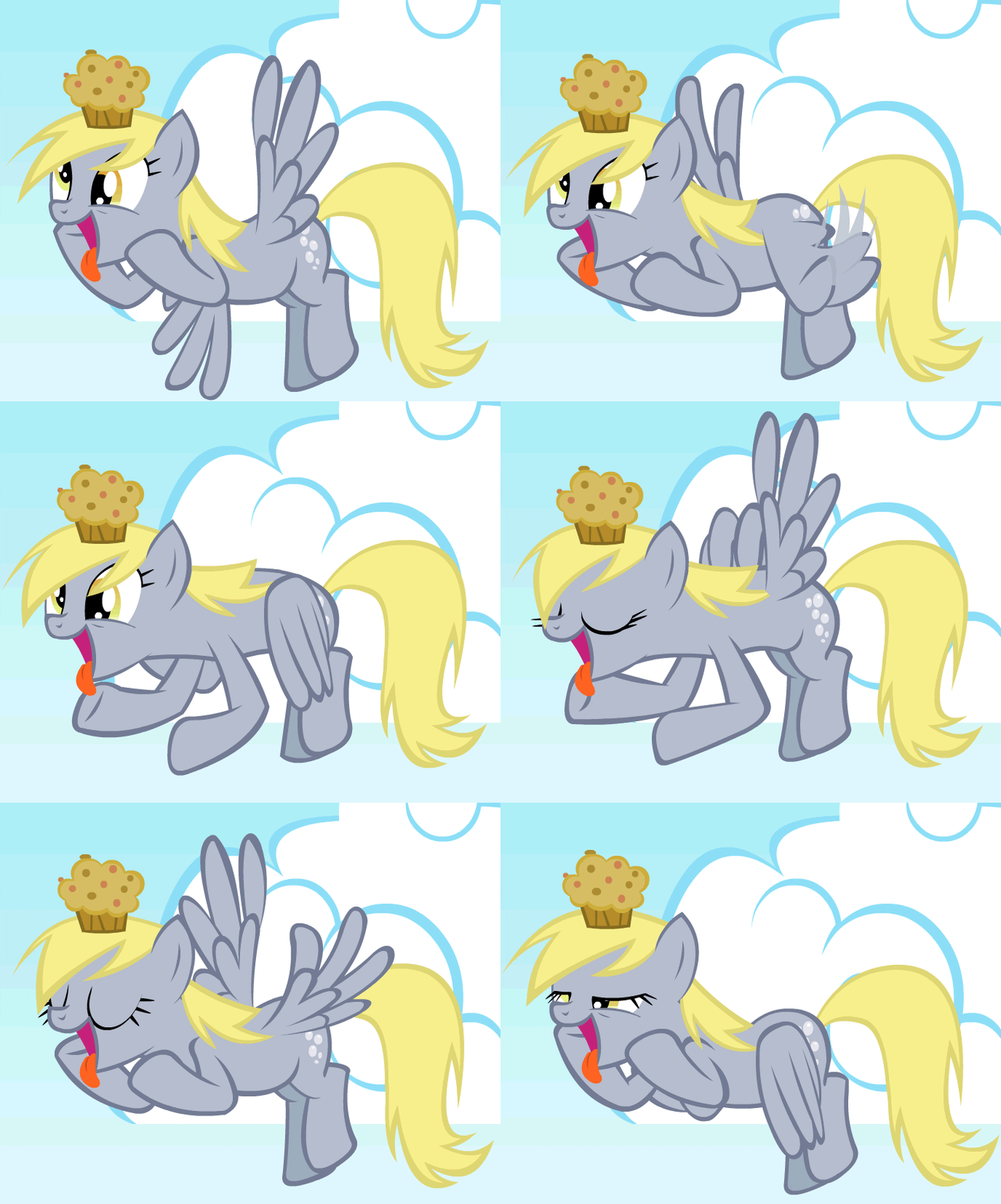
  • Derpy MLP 'The Last Roundup' intro. Clumsy cross eyed character. One of the only times you hear her voice, low and deeper, less attractive to children. Name is offensive. All indicators of her being dumber than other characters. Gerald from nemo link - similarly poor expressions of ability. https://www.youtube.com/watch?v=gzV0akONkWs (They changed her voice and eyes, and her name was deleted altogether.)
  • Hey Dougie Roly. Modern version of Tigger, childhood animated character watched by younger children. Fan suspected ADHD, shows viewer's  influence on franchise. Louder, hyperactive, energetic as described on BBCs webpage, but he can also be suddenly quiet and gentle. (https://www.heyduggee.com/characters/)
  • Timmy and Jimmy South Park. Just as capable, loved. Comedy about disabilities in a nice way. Characters aren't stupid and are just as able as the main 4, often having cooler experiences. Funny. Timmy won an award in 2008, 8 years after his character introduction. ("South Park Shortlisted In Disability Awards" by Damen Rose, Wednesday 19th November 2008 https://www.bbc.co.uk/blogs/ouch/2008/11/south_park_shortlisted_in_disa.html)

  • Winnie the Pooh, fan made theory of them all characterising a mental disorder. Allows little kids to associate and understand tough topics. Viral mental health test that showed what percentage of each character and their mental disorder you were. Theory started with Doctor Sarah Shea and her team with "Pathology in the hundred acre woods: a neurodevelopmental perspective on A.A.Milne 2000". Original journal shows Pooh showing Obesity and ADHD where as the viral test showed Pooh as ADD, and Tigger as ADHD - with other more modern interpretations as Pooh having an eating disorder. Audience's more modern views and acceptance of mental health have allowed people to interpret the characters' characteristics differently or in multiple ways to the mental health experts who wrote the original journal.

My results from the viral test: using data from Shea's journal on top of other sources
https://www.idrlabs.com/pooh-pathology/test.php
  • Nemo, ability used correctly. They don't make it obvious that EVERY character has a different disability, but everyone does and they all overcome it. So even if it's recognised, it's empowering to all audiences. Audiences were mad about Gerald and his offensive representation that him being cross eyed and having a unibrow makes him less smart.
https://tenor.com/view/gerald-finding-dory-angry-yelling-mood-gif-11663741

  • Bart Simpson ADD. Homer Simpson running gag of being dumb and small brained. Crayon in his brain. Bald, big eyes, voice = lower intelligence
  • Creature comforts (discomforts) by Aardman animations. Visibly trying to show awareness to different abilities by using disabled voice actors. Aired on Christmas Day of 2007, with extra characters added in 2008.
http://www.thunderchunky.co.uk/articles/creature-discomforts/

  • Peppa Pig recently adding in a character in a wheelchair
  • Live action very good use of ability is Baby Driver. Subtle yet very relatable. Use of music as comfort allowed for audiences to get behind the character by enjoying the music album and also listening to it with headphones. This is encouraged by the production team, as if you watch Baby Driver with headphones in, whenever one of Baby's earphones are removed, the music cuts in that earbud.

Saturday, 2 November 2019

12 Principles of Animation: Exaggeration

Exaggeration is using unrealistic proportions and overly expressive reactions to create an animated feeling of intensity.
Though this isn't the best illustrated, I think that the camera shake, the elephant's screaming expression, and the jaws of the mouth show clear exaggeration of the given sound effect of the scream. I feel like the exaggeration of the mouse would be more noticeable if the staging of the elephant was less central, and the proportion of the mouse was not so realistic and possibly started larger. (Or the elephant started smaller).

12 Principles of Animation: Antici....paaa...tion

Anticipation is the viewer's hope or expectation for an action or an event to happen. Anticipation can also be an action that you perform before you perform the wanted movement. Eg, leaning back before you rise from a chair.

Actions can either be bold, like in a comic book, or subtle, such as raising an eyebrow.

What went well with this animation, was the flip in the air and the drop. I was especially happy with the small bounce at the end to show it slowing down. In terms of anticipation, I think that the character design of a spring pop up toy was a universal indication of anticipating an action. However, I think I could have emphasised that pause for longer, so that the main action of anticipation was more obvious. I also think that I was very focused on the material of the toy, such as the rubber head and the wooden body. Due to this, the squash and stretch was only noticeable in the head, though I tried to thin the body slightly for a stretch motion. I think I should have encouraged the cartoon design and made the character less realistic in squash and stretch.

Monday, 28 October 2019

12 Principles of Animation: Squash and Stretch

Squashing is the act of flattening an object, giving it power or showing a build up of power (anticipation).

Stretching is the elongation of an object, often to show quick and exaggerated movements, giving the object an elastic effect.


Our strongest issue with our first attempt at a squash and stretch bounce was that we were too ambitious and we did not follow the instructions of the task, as we were supposed to do a drop down. I think as a moving ball animation, the faults in this are that the movement was either too fast on 12 fps or too slow on 24fps. Our S P A C I N G and timings against the walls seemed off.
To improve we attempted this again as a straight drop.
I think this one went really well. We only used squash and stretch during the first bounce against the floor, which emphasised the ball losing its elasticity as it bounced more. The spacing was shorter at the start and end, as in easy ease, with few spaces inbetween, and very close frames in succession for the quick bounces. 
For our side ways bounce we were able to create a good rolling transition from our bounces. However we realised that we needed at least another taller bounce due to the height and force of the initial drop. As well as this, to improve next time, our bounce should be less pointy and more curved. Despite this, I think that our stretches and squashes were well placed and the timing was effective for the curves we made.


I think if I had taken out frames from the end and added them in to the squash of the face in the sky, that would have given the piece better timing and made my intentions more clear. I know this timing issue came from my struggle in flipping the book, as it often paused around the squash of the cheeks pulling back, and so it felt like a longer action to me. 


12 Principles of Animation: Arcs

Arcs involve easy ease spacing, as there are more frames as the object begins to curve, and less as it accelerates before slowing again.

The simplest curve to demonstrate this is a pendulum arc, which we created using traditional drawing.
As I was trying hard to mirror the movement in this arc, with an even amount of frames (12), I created a large gap in the centre point of the arc. The teachers told me that this frame was the most necessary and so, I inserted it. Though I think my animation runs smoothly, next time I will push my frames even closer together at the two ends, so there is a larger gap in the middle, for realism. I also think I will trace the centre character a little more precisely, as the tail's line work did not shake and it made the character look poorly drawn. Though, this would be easier in digital work.

The second curve, we could animate in any format, as long as the medium was not hand drawn. I have found plastercine modeling to be fun and easy to think about motion in terms of spacing. 


I chose to continue with the pokemon azurill. I think the pokéball fell too slow, though the curve itself was alright. When I did this, we had not done squash and stretch, but now that we have, I know that I should probably have squashed and stretched the pokéball a little as it touched the ground, despite it's solidarity. I also think that the fall should have been quicker (less frames). Despite, I think that the movement of the pokemon returning to the hand, and the quick and admittedly accidentally withdrawal of the hand worked very well.


Wednesday, 23 October 2019

Context of Practice: Question 3

How is inclusive storytelling shaping the norms of representation amongst well-written characters in animation?

Inclusive storytelling: Includes everyone (LGBTQIA+, race, sex, age, personality, ability)

Gender:
  Disney:

  • Unnamed prince, lack of identity, all similar, yet everyone loves them purely based on appearance and voice. (Asides Navine from Princess and the Frog. Unconventional. Dependant on Tiana at times. Spoilt, no responsibility, lacking money)  
  • Princesses have always been role models for different values (eg. Common sense, kindness, adventure, hard work, bravery). But only Tiana, Merida and Mulan are role models that defy gender boundaries and appear as strong and capable.
  • Middle aged women are never portrayed. Even in recent movies, the mother always looks the same age as the daughter. (Fight to have Heleanor from Brave looking slightly older). When women look old, they are always the evil wrinkled witch or a wise elder.
  • Argue that Heleanors young appearance contrasts her change in to the big old bear.
  • Carl and Anger both have a similar square shape, one of a kind. Main protagonist middle aged, older people. Only middle aged men. 
  Marvel: 
  • Natasha Romanoff's death, a strong powerful moment for women as she saves all the male main cast and allows for the main battle.
  • Contrasts the very forced scene with all of the female characters of marvel fighting. Unnecessary in terms of plot because Captain Marvel could have done it on her own easily. 
  • Captain Marvel "Her"o trailers. Forced. Very active actor who gains hate from being outspoken.
  • Female costumes not looking like comic ones but looking more appropriate and less revealing.
  • Marvel has the gender issue of sticking to the comic books. Newer fans like all the inclusive story telling and costume changes. Fans from the comics want them to stop changing their childhoods for fake fans and newer fans. Audience's and actors influence on how characters change, because the actors liked not wearing the more revealing clothes (Johansson) and long hair wigs (Hemsworth).

Race:
  Whitewashing:

  • The Anicent One (Male Tibetan man)
  • Reversed white wash, Nick Fury
  • Reversed, Alteans Voltron?
  Disturbing:
  • "Jim Crow" Dumbo, Jim Crow was a dark coloured character in theatre who was racist, and a friend of slaves in America.
  • "Happy Hearted Rustabouts" song in Dumbo, shows men of colour working.
  • Mickey uses smoke to make his face black when dressing up in shaggy clothing to look like a poorer person.
  • Who made the indian red, song.
  • Stereotypes of Siamese cat playing piano with chopsticks in Aristocats.

Ability:
Every character in Nemo has something that effects their ability but allows them to overcome it. All except Gerald who never gets his moment of self approval. People were offended by his appearance and how drifted eyes and a unibrow equal someone being less capable. The soul purpose of Gerald was to be a gag like "Mine mine".
Nemo=Small fin - leads the group in Finding Dory.
Marlin=Anixety - travels across the ocean
Dory=short term memory loss - finds her family
Hank= PTSD - helps Dory escape
Whale Shark= eye sight - helps the beluga whale navigate his way through the ocean.
Beluga= Cant ecolocate and he does
Children are made aware of these by the plot but do not process how each character allows people to relate themselves to being able to overcome different struggles, like the characters.

Similarly, older teenagers and adults have come to notice or appreciate a theory that all of the Winnie the Pooh characters associate with different disorders. This theory has helped children understand different types of mental disorders and has helped them to find help and understand themselves.
As well as Roo showing Autism, these characters, memories of many peoples childhood in any generation, were never seen this way until recently. Audiences awareness in a growing society influences representation and inclusivity.


In character design, females always tend to have a round face with a small button nose and large round eyes, with the only exception being a slightly pointy chin. Where as the male characters have a diverse range of shapes in the face, nose and eyes. This is a Disney spread sheet, showing how they have not been inclusive towards women's appearances throughout their central female protagonists.
However, in Pixar's short Bao, though the mothers eyes are large and the nose is rounded, she is a very close step towards a more realistic idea of a woman.
Within Pixar, the characters from Inside Out are not supposed to be based on humans, and yet the emotions that are decided to seem more feminine have the same facial features, and the men have completely unrealistic extremes of facial shapes. The only exception is Sadness as a female character who is slightly plumper than the other skinny female characters. 

Cancel culture: Removing people from a production after they've done something wrong, such as James Gunn who was forgiven by the persuasion of fans and cast members alike. Jeremy Renner is currently under suspicion of being cut due to things hes said in the past and current obligations made between him and his wife in court, such as attempting his own suicide and being a drug addict. Emma Thompson quit a Skydance movie when John Lasseter joined the crew, once Pixar fired him.

Monday, 21 October 2019

Context of Practice: Question 2

How is the concept of nostalgia utilised by creators of animated content?

The current buying market in the 21st century are the millennial, and therefore creators are targeting their animations with nostalgia based around the 80s to 90s.
Creators use the aesthetic of nostalgia to give off this theme, such as:

  • Setting (Stranger Things 80s backdrop and synthetic sound effects/track, clothing, euphemisms, props)
  • Songs (Guardians of the Galaxy soundtracks)
  • Voices (Mufasa's voice in the live action lion king is the same)
  • Colour choices (Pop art 60s, Neon 70s etc)

Remake = Same movie, characters, plot, new drawing style, nostalgia in playing the same songs and modernising the story only in the technology used to make it.
Reboot= Different character traits, additional characters, more modernised plot, often refers back to the predecessor for aspects of nostalgia to show how times have changed between, or to make fun of the original.

2018-2019 have become the era of rebooting movies because of the high responses from the buying market, seeing their childhood Disney characters reimagined with the newer CGI animation. These movies gave struggled between popularity and negative backlash, as most of the time, the characters are intended to look animated and bouncy to maintain their excitable characteristics - but also to maintain societies standards for a hyper realistic CGI visual experience. This was experienced mostly with the new live action Lion King, as they were expected to keep in the songs for the aspect of nostalgia, however realistic looking animals singing and dancing did not look quite realistic and ruined the visual aesthetic of the movie, causing lots of people to hate it or not watch it.
Similarly Disney faces the same conflict with Mulan, as it arguably contains some of Disney's most popular songs, but they plan to keep it out to maintain the more serious new war/ action focus of the movie. This has caused backlash to the movie prior to the cinematic trailer has even been released. But then Disney can either keep the nostalgic songs, or keep their intention of not to make the exact same movie.

In comparison to Disney's live action remakes, they have also make reboots of shows, such as Ducktales, with more in the works for Disney plus. Their show has recieved higher forms of praise than a lot of their movies and I think this is down to a lack of nostalgia. With Ducktales, it is aired on a children's tv channel, Disney XD, in comparison to the big broad realm of cinema. Children in the 21st century are not essentially the buying market for a show such as Ducktales, but I believe this works in Disney's favour, as they now have feedback from other generations saying what worked and what didn't, and rebooted their characters accordingly with a modern take. The loveable animation has never changed. Also, children have a narrow access to the original Ducktales show, as there may only be small clips surfacing on YouTube. Therefore, the programme does not have to live up to certain expectations with the main target audience - but if the expectations are met, will encourage the parents of these children to enjoy the show too - creating a vaster consumerist market.

Intro comparison
The comic book layout gives hints to the older designs of the characters, whilst also maintaining the modern transitions and parallax throughout the characters running sequence. The new music is also a more positive addition to the reboot as it is more upbeat but keeping to the same tune.

Audiences influence a lot of decision making in modern day reboots due to the high expectations of the audience, and the standard of pleasing the audience that the creators have. Social media has been a strong influencer in this as proven recently with the live action sonic, and the hate towards the design - as well as spiderman being with the MCU or Sony. Both were fixed in the audience's favour due to backlash. 

Sunday, 20 October 2019

12 Principles of Animation: Timing and Spacing

Timing: Selecting the best moment for something to happen in the frame. Choosing the best moment will have the optimum effect on the audience. This is also recording an action, which is done in animation when filming reference for movement, and creating your animation with precise or exaggerated timing.

Spacing: Placing the necessary about of spaces between frames.

  1. Linear spacing: Frames spaced equally apart. The animation will happen at a constant speed, which will make it look mechanical or unnatural.
  2. Ease in spacing: Used for deceleration and halting an object. The spaces are further apart at the beginning of the movement.
  3. Ease out spacing: Used during acceleration, so the frames are closer together at the start.
  4. Easy ease spacing: Combinstion of ease in and out. The frames are closer together at the start and the end, making this a good motion for animating a pendulum or a clock.

"What happens inbetween each image is more important than what's in each image." The animation won't be believable if the movement is inconsistent.

Testing Timing and Spacing
Blinking Character


My designed character has a scarred eye and so in my animation I thought that a longer blink would be the best characteristic for him. This also shows how tired he is, as a constant neighbouring character in the shadows of the night. I thought a quick blink of his scarred eye would be best too as it might be harder for him to focus with that eye. Though there isnt much difference between my two attempts, I thought that the first was too quick and it felt like his eye was twitching, but faster than humanly possible. 


Saluting
Fudging the timing: I tried this with 12 frames per drawing at 24fps, and then at 6 frames per drawing at 24fps. This helped me to understand how mechanical my arm movement was in my drawings and how many frames I would need to turn it in to a smooth motion.


I think the final outcome had good motion to it, but my line work could have been a bit smoother in places. I like the smooth transition in each frame of the arm and I think the pause before the hand salutes is realistic to life.

Animation Autopsy 1

Traditional Animation is when an artist draws every frame by hand.

A thaumatrope is when two images are merged in to one by pulling on a string attached to a two sided drawing. (1827)

A phenakistoscope is a disk split in to sections, with the frames of animation drawn across each. When spun, the animation comes to life. (1841)

A zoetrope is a cylinder that you spin, and the animation is shown through the gaps in the outer edge. (1866)

The flipbook was created in 1868.

The praxinoscope was similar to the zoetrope but you watch the middle where there were inverted spinning mirrors. This was easier to view than the zoetrope. (1876)

Rotoscoping allows animators to trace over moving images, frame by frame. Before this, animators projected images on to glass. (1917-1919)

In 1923, Disney started up and co-produced Alice's Wild West Show, the first mixed media animation. 

In 1932, Disney created the first Oscar winning animation, "Flowers and trees",  which was the first ever technicolor animation. 

The multiplane camera, as created for Snow White in 1937, was tested in the film "The old mill". This camera gives depth and parallax, which is best demonstrated in Pinocchio as the camera moves around the towns folk. 

Disney begun to recycle animations from other movies to speed up the animation process, as they often used human studies for reference in their work. 

Disney began printing on acetate, a clear material, throughout their golden age, but this began to be too expensive to keep up and so they stopped before the start of the silver age.

The introduction of the photocopier in 1938 aided in traditional animation, as repeated frames were no longer repeatedly drawn. 

Digital animation arose in the 1980s.

12 Principles of Animation: Straight Ahead and Pose To Pose

Straight Ahead

  • The animation is made one frame after another.
  • Usually stop motion as it cannot be done easily in 'Pose to Pose'.
  • Good for fluid motions such as: fire, water and bouncy characters.
  • An entire shot is done by one artist so that there's continuity in that section of the production.

Pose to Pose
  • Key animator creates the key frames A and B and the other animators create the inbetweens with reference for other actions in the middle.
  • Key frames = Extreme motion
  • Break down = Centre shot between A and B
  • Inbetweens = Last frames to be inserted.
  • More effective for team animations and for time limits and due dates.


Amalgamation

  • Key frames with looser inbetweens.
  • A combination of 'Straight Ahead' and 'Pose to Pose'.

Wednesday, 16 October 2019

Context of Practice: Question 1

How have technologies influenced our expectations of style in 21st animation?


  • CG (Computer Generated): Visual effects, 3D modeling, 2D Adobe animation, photoshop, motion capture. Anything that uses software on a computer to be created. CG was actually first included in a movie in the 20th century, in Westworld (1973). Although the first fully CG animated movie was Toy Story, movies before such as Westworld and Tron, one of the inspirations for Toy Story's bold animation movement, had combined live action with animation.

  • VR (Virtual Reality): Oculus, Omni, arcade games, Nintendo virtual boy. Immersive technology that separates the user from real life inside a fake reality. SEGA attempted to create their own virtual reality headset however failed to complete it, and so their rival, Nintendo created the Virtual Boy. The knowledge about the technology was not advanced enough at the time, and so the picture quality was limited to polygons and the hue of the screen was entirely red. It was also very difficult to wear for long periods of time due to the movement in the video games themselves. 

  • AR (Augmented Reality): Pokemon Go, Nintendo AR cards, IG filters. Using cameras to add virtual objects in to the real world like an overlay. Not interactive but it can react to movement of the camera, such as instagram filters using a framework of a person's face which moves as the face moves. In 1993 Mike Abernathy was the leader engineer in the first AR video overlay. From this he was able to pioneer the creation of the Landform (1995) inside his company Rapid Imaging Software, which was used in a helicopter flight test in 1999. He went on to do further work for NASA in the 21st Century.

  • MR (Mixed Reality): Similar to AR but this allows the user to interact with the virtual objects, such as grabbing it and moving it - for instance, Iron Man moving Jarvis' holograms or headsets that also use controllers to follow the users hand movement. Virtual Fixtures, created for the US Air Force was the first immersive example of full functional AR technology. This enveloped the user with sound, visuals,and touch using human motion. This was created by Armstrong Laboratories in 1992.
  • AM (Additive Manufacturing): Often referred to as 3D printing. This is used in animation to print character faces for puppets in a stop motion - as often shown in additional scenes of Laika movies such as Kubo. The concept of 3D printing was first thought up in 1974, proven by an article in the Ariadne written by David H.E.Jones. This was made reality in 1981 by hardening photographs to create 3D models made of plastic.

Sunday, 13 October 2019

12 Principles of Animation: Staging and Storyboarding

This principle is how the animation team directs the composition of the scene. It allows you to decide on the best placements within the scene so that the audience's attention is drawn to the most important element as and when needed for the story.

Different elements in staging can alter the same scene so that the audiences emotions are different each time. This can be done by using different hues of lighting: Red meaning danger and pink meaning love are similar but they emotions created are very different.

Notes:

  • Screen size = 16 x 9
  • Use boxes and arrows in a story board to show a pan or a zoom, keeping the story board panel the size of however many full screens needed.
  • To show a fade in a storyboard, add an arrow to the side.

In this storyboard, the red arrows show movement. I wanted to display lots of different camera angles as well as a transition between the clouds and the sun. I think by starting and ending with very similar frames, the animation would act like a child's nursery rhyme where the structures of the stanzas are very similar and only altered slightly, so they can be played on repeat.


The scene setter for Incy Wincy Spider is uses a bird's eye view to show the scale of the spider in comparison to the water droplet, showing how easy he can be taken down the drain. It also shows his unnatural scale against the drain pipe and grid (although there are large spiders in the real world). My spider's scale is larger than the norm to show the child like interpretation of the character to he has appeal to young children and is easy to read against everything that is happening in the scene. He is usually the only character in the nursery rhyme and so his scale uses staging to show that he is what needs to be the main focus at all times.

12 Principles of Animation : Appeal

Appeal is the equivalent of charisma within the animation industry, as it attracts attention towards the design, movement, voices, shapes, and colour of the production in both character and set.

Protagonist tend to have round shapes in their solid form, with large and expressive facial features that give off a friendly expression. They have higher waists to make the body look more inaccurately appealing, reinforced by their bright and often primary colour palette.

Antagonists have realistic proportions which often makes them look lanky in comparison to the antagonist. Their facial features are sharp which gives a cruel expression. They often have a darker colour palette that consists of a lot of the secondary colours , or darker tones of the primary ones, like a blood red. Antagonists have strange additions to their appearance that make them stand out, such as a cape, or a staff or an odd shaped helmet and often, a scar.

My idea for this character was to create someone in the middle ground to see how their appearance would vary. Calico is a helper, very much like Alfred from Batman, but I have given him an element of mystery to hide his background and make him more of an interesting and intriguing character so he appeals to the audience and isn't simply someone in the background.
I tried to mix his facial features so they weren't too sharp or too soft, creating a sense of ambiguity.


I ended up switching around the red and blue elements in his suit so the pants didn't blend in with my previously chosen dark brown fur. I didn't change the fur colour as golden and white cats are often happy in animatics involving animals, and black is a very negative colour, so I wanted a middle ground. I also loosened his clothing so that he did not look so stiff and angular like an antagonist.


Friday, 4 October 2019

12 Principles of Animation: Solid Drawing

In class, we were given the basic object of a walnut to help demonstrate the first of the twelve principles of animation, Solid Drawing. This is the dimension of weight and perspective in dynamic proportions.

We were told to draw what we saw in still life, as well as patterns on the shell's texture and interpretative one line drawings.
The one I found the most appealing was drawing the inside of the nut without opening it to see for ourselves.
From this we were told to redraw in a more detailed way. I decided to make my drawing more unrealistic, and based it off of the idea that the walnut shell was a home for the nut inside, and anything else could be living inside my closed walnut with it.
This gave me the idea to draw a creature holding the same nut.
The next activity was turn our drawing in to a character. As I had already made a character, I tried to figure out how I could get rid of the shell and nut part of my drawing. My original sketch made the shell look a lot like a cave, and so when I thought of an animated character living inside of a cave, my first thought was Yogi Bear.
I kept the same shape I had drawn throughout for the cave and used the nut as the basic form for the belly of my bear character.

During this sketch, I decided that I hadn't incorporated any detail of the walnut's texture in my character. As my background was a part of the character design, using the cave, I decided to add the textures that I documented during the walnut experiments on to the trees and the roof of the cave. This was carried throughout my later bear drawings.


After this we did model studies off of our teacher with the purpose to find the line of motion and create quick ideas of posture using basic forms.
Some were done in ten seconds, some in thirty, and some in a minute. 
I then used one of my one minute studies and fully rendered it with colour. In this study I made it look like my teacher, as I could picture him doing the pose in my mind and where the lighting was in the original to fully represent the light of the study.

After this I used two other poses from our observations to draw my bear. Doing this taught me the importance of the line of motion, as my bear's proportions were very different to Ben's and any other human figure. As a person with a comic-book-art-like style, most of my off head base sketches for a pose would be drawn as very unrealistic human figures with wide chests and thinner waists. The line of motion allowed me to create the pose to my bear's proportions despite his stomach being so long in comparison to the base sketches.


Monday, 30 September 2019

Animation Research: Library Study


30/9/19

Today we were first introduced to our university library and I looked in to three books about animation, design and concept art.

Books:

  • Secrets of Digital Animation
  • Disney: Layout & Background
  • The Art of The Boxtrolls

Artist research:

Michael Knapp
Knapp was inspired by the classical age of Disney such as Sleeping Beauty, as well as the traditional sketch art featured within the Hobbit book published through Rankin/Bass.
His area of studies surrounded him with inspiration towards the Renaissance era which he featured throughout his portfolio to represent the humble beginnings of his very simple characters. 
Though his characters have a rather complex story within their design and influence, they are drawn very simply, using loose forms to create basic shapes and silhouettes for each character. Knapp says that seeing the main silhouette helps him to see whether his proportions are to his liking. 
Lots of his characters feature small eyes, which reinforces the movement of his characters, as most of his emotions are shown in movement and not expressions.
Knapp didn't want to be a runner for a large company like Disney only to never see his work finished, so he focused on illustration and has since worked on Ice Age 3 and Dr Seuss.


Disney artists are known in their earlier works to hand paint each frame of their feature length animations. Storyboards for some of their pieces show how the artists painted one large scene and marked where they would like the pan of the camera lenses to start and end - creating a movement of multiple frames without having to redraw the same scene. Their storyboards also use arrows to represent where they plan for the lighting and or movement to go.
  
Disney often use wide angle camera shots in their scenic pieces to emphasise the size of the landscape, often to show off their stunning feats of background art within the animation. 


One of the Boxtrolls leads, Travis Knight describes his characters as "colourful", despite also saying that the grim conditions of the Boxtrolls' lives and the personalities of the humans, are reflected in the grim design of the characters.
Despite the dark setting of the night, the Boxtrolls are often shown as safe and alive. The Laika animation company use the motif of small amounts of darkness in the light to show hope; almost symbolizing guidance through the dangerous streets using street lights and windows. This strongly contrasts the bright colours of the day which show a permanent exposure of the grotesque character designs of the humans, making the box trolls look sweet and friendly and harmless in comparison - reinforcing the narrative that it's not safe to be out in the day. 

The Boxtrolls subtly explores politics and modern day corruption, most commonly shown in the discrimination towards the Boxtrolls looks. To the humans of the movie, the Trolls are the horrid looking and terrifying creatures - but the character design clearly reinforces how the viewer is meant to be able to see past the social view and see how the humans are the monsters - a lot like the lead character Eggs does.

I have learnt that the intended design created within the story boarding process can often look completely different to the final outcome of the piece, and that it is good to experiment with multiple different designs for one character, and to explore every angle of the face.


Introductory post

Hi my name is Farah and I'm an animation student at Leeds Arts University 
who is inspired by comic book art and animation in the film industry.

Evaluation D&AD

 As a final result, I think we had definitely produced the work that we aimed to. It was clear and stuck to the newer Giffgaff emoji kind of...